Mercedes-Benz’s Journey to End-to-End Value Creation
By Mirko Kleiner | Blog Series | August 2026
The future of organizations won’t be shaped by AI alone. At the LAP Alliance, we connect Leadership, New Operating Models, Business Ecosystems, and emerging Technologies to explore what it really takes to thrive in the AI Era.
One standout example is Haier — a global pioneer that transformed from a traditional manufacturer into an entrepreneurial ecosystem, inspiring progressive organizations worldwide while achieving remarkable, sustained 20% growth.
I’m honored to be part of a select group of international experts collaborating with the Haier Model Institute, alongside thought leaders including Gary Hamel, Bill Fischer, and Umberto Lago.
This year, the LAP Alliance will once again join the Haier ZeroDX Forum & Awards — where pioneers from around the world come together to share how they are reinventing management.
In this new blog series, we’ll bring those insights to you: real cases, bold experiments, and practical lessons from the Haier Zero Distance Excellence Awards 2026 — exploring how AI, entrepreneurship, and business ecosystems are redefining the future of organizations.
Post 3 - Mercedes Case Study
Mercedes, global, https://www.mercedes-benz.com/de/
By Mirko Kleiner interviewing Simon Kienzle, Manager | Transformation Design Lead
Guest Case Study | August 2026
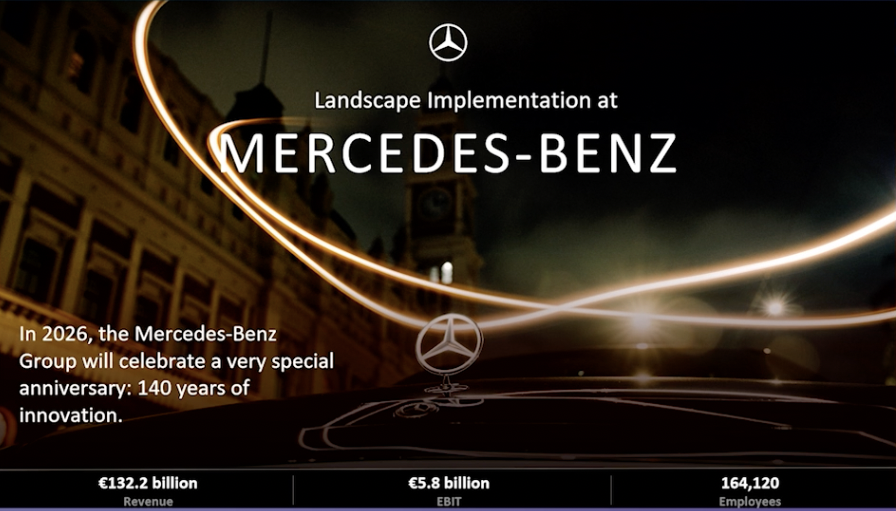
Image source: Mercedes
Mercedes-Benz is one of the world’s most iconic automotive brands, with nearly 140 years of engineering heritage and a global reputation for innovation, quality, and premium mobility.
As the automotive industry shifts toward software-defined vehicles and AI-powered mobility, Mercedes-Benz is rethinking not only its technology, but also how value is created across the organization - from individual domains and suppliers to end-to-end customer value streams.
Introduction
Mercedes-Benz is transforming one of the world’s most established automotive development organizations for a fundamentally different era of mobility.
The shift toward software-defined vehicles, centralized high-performance computing and increasingly interconnected customer functions is changing not only what Mercedes-Benz develops, but also how the organization needs to work. Hardware, software, vehicle functions, testing, manufacturing and external partners can no longer optimize independently. Ultimately, the customer does not buy a specific component, an ADAS software or an infotainment software. The customer experiences an integrated vehicle and the functions it provides.
This insight is driving Mercedes-Benz toward a more radical form of end-to-end value-stream orientation: organizing work around customer value rather than existing organizational boundaries.
The journey is already substantial. Within the MB.OS (Mercedes Benz Operating System) environment, Mercedes-Benz has established a Value Stream Landscape, launched more than 50 Agile Release Trains (ARTs) and four Solutions. Yet Simon Kienzle estimates that the transformed areas still represent only a minority of the overall system.
Initial Situation / Challenge
Mercedes-Benz brings approximately 140 years of organizational experience, engineering excellence and industrial capability. That heritage is an enormous strength, but it also creates organizational, technological and cultural legacy.
The traditional organization was largely structured around specialized hardware and software domains. Each domain had clear responsibilities, its own management structures, processes, tools, budgets and KPIs.
The challenge is that customer value no longer follows these organizational boundaries.
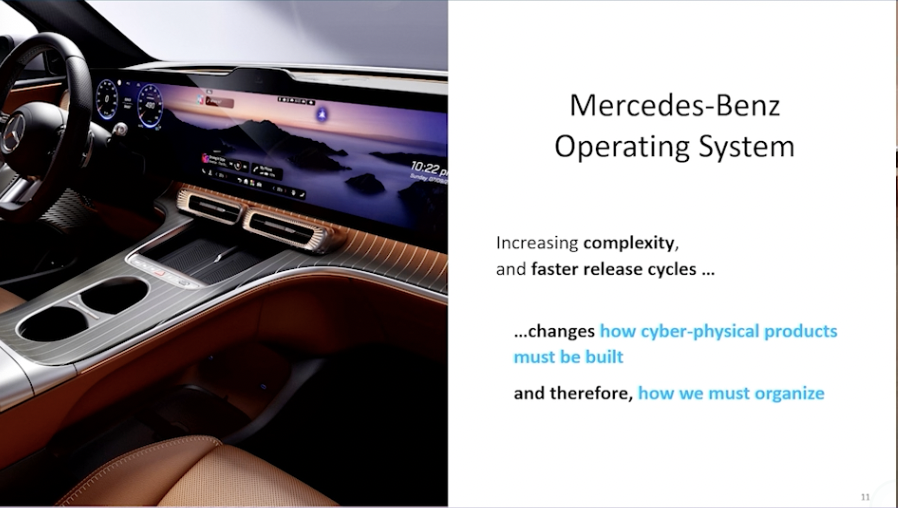
Image source: Mercedes
A customer function may depend simultaneously on architecture, hardware oriented value streams, software value streams and several internal and external contributors. Consequently, optimizing each domain independently can result in a locally efficient organization while the overall customer outcome remains slow, expensive or unreliable.
As Simon Kienzle described it, one of the fundamental questions became surprisingly simple:
“For whom are we actually creating value?”
Traditional dashboards and team-level KPIs could show whether individual units were performing, but they did not necessarily reveal where the overall value stream was constrained. Mercedes-Benz therefore recognized that establishing agile teams or ARTs alone was not sufficient. Simply placing a new collaboration model on top of an existing organization can reproduce the same silos in a different structure.
The challenge becomes particularly visible where customer functions cross domains. These areas require substantial coordination and often lack clear end-to-end ownership. Individual leaders naturally optimize their respective components, while nobody has sufficient end-to-end responsibility for optimizing the entire customer function.
This creates several systemic problems:
● Local instead of global optimization: domains optimize their individual contribution rather than the overall customer outcome.
● Late integration and feedback: problems may only become visible during final integration, triggering investigations and task forces.
● Different development speeds: software can iterate significantly faster than hardware, yet both ultimately have to converge in the vehicle.
● Fragmented decision-making: cross-functional teams may collaborate differently while important decisions remain in the hierarchy.
● Fragmented tooling and standards: different domains use different tools, testing approaches and working standards.
● Limited financial transparency: costs are traditionally associated with projects and organizational units rather than end-to-end customer functions.
● Supplier boundaries: external partners are essential contributors, yet contractual structures do not always allow them to operate as integrated members of the value stream.
The complexity increases further because development is globally distributed across locations including Germany, India and China.
Ambition / Approach
Mercedes-Benz therefore began moving beyond conventional transformation toward a more fundamental question:
How should the organization be designed if customer value - not the existing hierarchy - is the starting point?
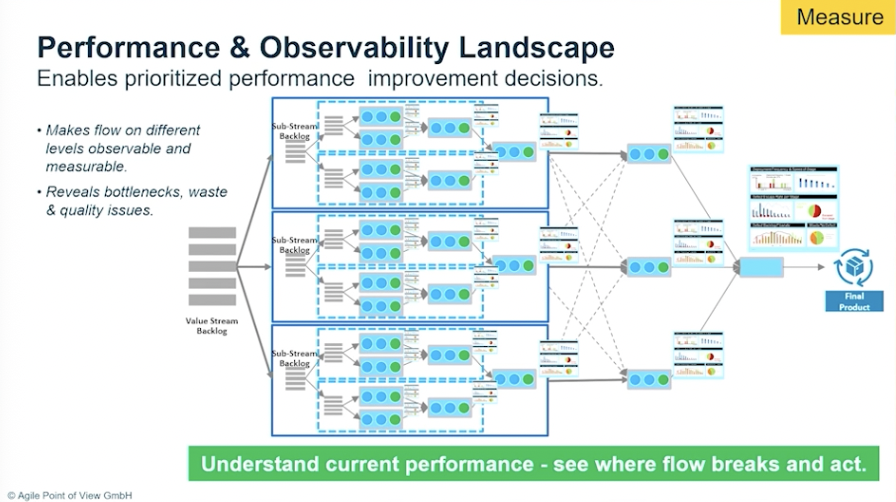
Image source: Mercedes
1. Start with the Value Stream Landscape
One of the most important lessons was not to let every organizational unit independently define its own value stream.
Mercedes-Benz created an overarching Value Stream Landscape representing how customer functions and products are created across MB.OS. The landscape provides a target picture showing where value is generated independently of the existing hierarchy.
This creates a “Single Source of Truth” through which employees can trace their contribution from their team through ART and value stream up to the overall product.
Rather than transforming the hierarchy bottom-up into new “silos,” the organization can start with the product and customer outcome and then ask:
Who actually needs to work together to deliver this value?
2. Shift from Domain Ownership to Customer-Function Ownership
Mercedes-Benz is increasingly recognizing that ownership needs to exist at the level at which the customer experiences value.
For cross-domain functions, traditional Component Ownership inside individual domains is insufficient. Someone must take responsibility for the integrated customer value.
This represents an important shift:
from owning components or software → to owning customer functions.
The organizational implication is significant. Hardware, software and domain teams remain important, but their collaboration needs to be orchestrated around the overall customer value.
3. Make the End-to-End Flow Transparent
Mercedes-Benz began mapping the “assembly lines” of development - not as linear manufacturing processes, but as interconnected learning and integration cycles.
The objective is to expose:
dependencies, handovers, integration points, bottlenecks, testing cycles and feedback loops.
Current states can then be compared with future states designed to reduce dependencies and enable more cross-domain collaboration.
The goal is not simply faster execution. It is to accelerate learning cycles.
Instead of discovering an integration problem months or years later, the ambition is to receive feedback after a sprint, correct the issue and continue learning.
4. Move from Team KPIs to End-to-End Value-Stream KPIs
Mercedes-Benz is complementing team and organizational metrics with cross-value-stream KPIs.
Rather than only asking whether individual teams perform well, the organization can ask:
How quickly can a patch be delivered? Where does quality deteriorate? Where is lead time lost? At which integration point does the system slow down?
Mercedes-Benz is establishing common quality KPIs that can be followed from coding through module and component integration across several organizational levels.
This creates the transparency required to move from opinions and escalation toward fact-based self-correction.
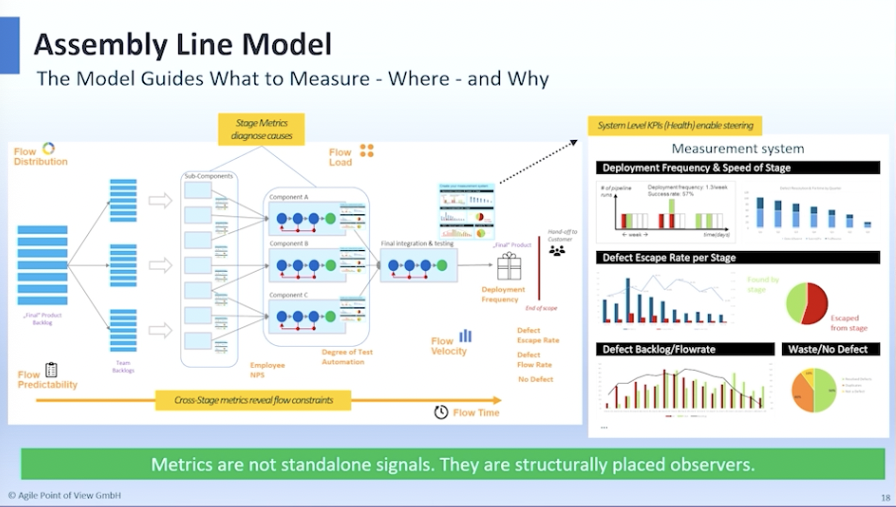
Image source: Mercedes
5. Decouple to Enable Autonomy
A further ambition is to make systems sufficiently modular that teams and partners can develop autonomously without creating integration chaos.
In the component development context, this includes establishing clearer system boundaries and explicit contracts across interfaces: defining responsibilities, interfaces and how components will be integrated and tested.
The underlying principle is powerful:
Without decoupling, there is no real autonomy.
Combined with virtualization, digital twins, automated testing and Continuous Delivery, this can allow hardware and software components with different lifecycles to evolve independently while still integrating into a functioning overall system.
6. Bring External Partners into the Value Stream
Mercedes-Benz also recognizes that internal transformation alone cannot deliver the required speed. Partners and suppliers need to become part of the operating model.
In more mature value streams, suppliers already participate as ecosystem partners in planning and delivery cadences. Representatives can participate in PI Planning and translate requirements into their own organizations. However, existing contractual models still limit how deeply partners can be integrated.
Outcomes
The transformation is still underway, so its most important outcomes are currently structural capabilities and increased transparency rather than final business-performance claims.
Nevertheless, several significant results are already visible.
A common Value Stream Landscape has been established. Mercedes-Benz now has an overarching model for understanding customer functions and the value streams contributing to them. This provides orientation beyond the hierarchy and increasingly allows employees to understand how their work contributes to the overall product.
More than 50 ARTs and four Solutions have been launched. This creates a substantial base of experience from which the next phase of transformation can scale.
Cross-domain dependencies are becoming transparent. Instead of treating late integration failures as isolated technical problems, Mercedes-Benz can increasingly visualize how hardware, software and organizational dependencies interact and design streamlined future states.
End-to-end performance measurement is emerging. Common quality and flow KPIs are being introduced across value streams, enabling problems to be located across the overall delivery system rather than only within individual teams.
Value-stream-based financial transparency is becoming possible. The Value Stream Landscape provides the foundation for moving budget allocation from projects toward value streams. The ambition is to understand what an entire value stream or customer function costs, enabling better prioritization and eventually genuine portfolio management.
Supplier collaboration is moving closer to integrated ecosystem collaboration. Suppliers are already included in planning in some agile areas, while the organization is exploring how contracts and engineering relationships must evolve to enable deeper collaboration.
Key Insights for Other Organizations
1. Start with customer value - not the organization chart
Bottom-up transformation alone tends to reproduce existing organizational boundaries. First establish the end-to-end value landscape having the customer and its needs in focus and then allow the organization to evolve toward it.
2. Agile structures do not automatically create agility
Creating teams, ARTs or new roles does not solve the underlying problem if decision rights, budgets and accountability remain elsewhere.
Autonomy requires actual authority.
3. Optimize the whole, not the individual parts
Excellent local KPIs can coexist with poor overall customer outcomes. Measure flow, quality and performance across the complete value stream.
4. Make dependencies explicit - then decouple
Autonomy does not mean independence without coordination. Clear interfaces, integration agreements and mutual expectations allow individual components to evolve faster while preserving the integrity of the overall system.
5. Treat suppliers as part of the operating model
If a critical supplier cannot iterate, test and learn at the same speed as the internal organization, internal agility has limited value.
6. Accelerate learning, not simply delivery
Especially in complex hardware/software environments, the decisive capability is how quickly the organization can test assumptions, detect integration problems and respond.
7. Transformation should increasingly be problem-driven
Mercedes-Benz is moving away from expecting every remaining area to complete the same multi-year transformation journey. Instead, value-stream KPIs identify concrete quality, flow or tooling problems. Transformation capabilities can then be deployed where they solve an actual business problem - for example Value Stream Mapping, organizational redesign or CI/CD enablement.
This changes transformation from “implement the model” to “solve the problem - and evolve the operating model while doing so.”
Conclusion
Mercedes-Benz's journey illustrates a fundamental challenge facing established organizations in the AI and software-defined era:
Technology can only move as fast as the organization around it allows.
The transformation therefore goes far beyond introducing value streams. Mercedes-Benz is gradually redesigning the system of value creation itself - from domain optimization toward customer functions, from projects toward value streams, from isolated KPIs toward end-to-end transparency, from late integration toward continuous learning, and from supplier transactions toward integrated partner ecosystems.
Although Mercedes-Benz is not explicitly implementing the ZER0 Management Model, its direction demonstrates several of the same principles.
The Value Stream Landscape moves the organization closer to Zero Distance to the user. Customer-value ownership shifts accountability toward entrepreneurial ownership of outcomes. Cross-domain value streams increasingly resemble ecosystems of autonomous contributors. Interface agreements point toward the logic of EMC Contracts. Deeper supplier integration reflects External Entities and ecosystem thinking. And end-to-end KPIs create the transparency required for continuous self-correction.
Perhaps most importantly, Mercedes-Benz is beginning to move away from transforming the organization for the sake of transformation.
Instead, the emerging logic is:
Make customer value visible. Make problems transparent. Bring the right people and partners together. Give them the ability to act. Measure the outcome. Learn. Adapt.
That is also at the heart of ZER0.
And it creates the basis for a Win3 outcome: better experiences and faster innovation for customers, greater autonomy and clarity for employees and partners, and a more competitive and resilient Mercedes-Benz ecosystem.
Outlook / Whats next
The next challenge is scale.
The first wave of transformation has created more than 50 ARTs, four Solutions, a Value Stream Landscape, transformation expertise and a growing set of enablement capabilities. But much of the wider organization still operates through traditional project and domain structures.
Rather than waiting years for the remaining organization to follow the same transformation journey, Mercedes-Benz is therefore shifting toward a problem-driven scaling model.
Value-stream KPIs will increasingly identify where quality, lead time, tooling or collaboration problems exist. Transformation experts can then intervene with the appropriate capability: problem solving, Value Stream Mapping, CI/CD enablement, organizational redesign or another element of the transformation playbook. The effect of that intervention can subsequently be measured again through the value-stream KPIs.
Video / Keynote
All Posts of this Series
Post 1 - A Preview of the Haier ZeroDX Awards 2026
Post 2 - P3 Group Case Study
Post 3 - Embraer Case Study
Post 4 - Gel Studios Case Study
Post 5 - Mercedes Case Study
Post 6 - foryouandyourcustomers Case Study
Post 7 - The Haier ZeroDX Awards 2026 (Staytuned - later in Sep/Oct)