How Embraer Reinvented Aftermarket Contracting Around the Customer
By Mirko Kleiner | Blog Series | August 2026
The future of organizations won’t be shaped by AI alone. At the LAP Alliance, we connect Leadership, New Operating Models, Business Ecosystems, and emerging Technologies to explore what it really takes to thrive in the AI Era.
One standout example is Haier — a global pioneer that transformed from a traditional manufacturer into an entrepreneurial ecosystem, inspiring progressive organizations worldwide while achieving remarkable, sustained 20% growth.
I’m honored to be part of a select group of international experts collaborating with the Haier Model Institute, alongside thought leaders including Gary Hamel, Bill Fischer, and Umberto Lago.
This year, the LAP Alliance will once again join the Haier ZeroDX Forum & Awards — where pioneers from around the world come together to share how they are reinventing management.
In this new blog series, we’ll bring those insights to you: real cases, bold experiments, and practical lessons from the Haier Zero Distance Excellence Awards 2026 — exploring how AI, entrepreneurship, and business ecosystems are redefining the future of organizations.
Post 2 - Embraer Case Study
Embrear, Global, http://embraer.com/
By Mirko Kleiner interviewing FILIPE LISBOA MALDONADO, Associate general counsel | Embraer
Guest Case Study | August 2026
Image source: embraer
Introduction
In aviation, complexity is unavoidable. Bureaucracy does not have to be.
Embraer, one of the world’s leading aerospace companies, provides its airline customers with a broad portfolio of aftermarket services throughout the lifecycle of an aircraft. These range from spare parts and digital services to technical support, training, engineering services and even the temporary provision of pilots and mechanics.
Yet accessing these services could involve something familiar to many large organizations: another contract, another legal review and another negotiation.
The spark for changing this came directly from a customer.
During a visit to one European customer approximately seven years ago, Embraer heard a simple but powerful ambition: the airline wanted to be able to engage additional Embraer services without repeatedly having to involve the legal departments.
That customer challenge became the starting point for Single - Embraer’s attempt to create one contractual foundation covering almost its entire aftermarket service portfolioand making the experience of customer in navigating throughout its complex entity structure painless.
Instead of repeatedly negotiating the rules of collaboration, customer and Embraer agree on them once. From then on, individual needs can be fulfilled through a much simpler request, quotation and purchase-order process.
What started as a contracting challenge became an example of a much bigger idea: reducing organizational distance between a customer need and the people capable of fulfilling it.
Initial Situation / Challenge
Embraer operates in an environment where safety, liability, insurance and regulatory requirements make robust governance essential. Simplification therefore cannot mean simply removing contractual protections.
At the same time, the traditional contracting model created friction.
Different services could require different contractual arrangements and repeated legal involvement. Across the full range of services, the underlying contractual documentation could amount to hundreds of pages. Filipe estimates that, taken together, the traditional contractual frameworks could easily reach 500 pages or more.
The problem was not that Embraer wanted less governance. The problem was that governance had become repeatedly coupled to individual transactions, taking more time than the service itself.
This mattered because customers use Embraer services in very different ways and at very different speeds.
A spare part can be an immediate transaction. Access to the FlyEmbraer digital ecosystem platform can involve annual subscriptions. Training might last several days or weeks. Pilot services might be required for a single ferry flight or for several months while an airline builds its own operational capability. An engineering solution may take months to be developed and implemented.
Yet each new requirement could potentially trigger another contracting cycle.
This created a paradox: Embraer could be ready to serve the customer, while the organizational mechanisms surrounding the transaction slowed the customer down.
The challenge was therefore straightforward but ambitious:
Could Embraer retain the protections required in aviation while removing the recurring bureaucracy between customer demand and service delivery?
Ambition / Approach
Embraer responded by questioning a fundamental assumption: Why should every new service require a new contractual negotiation?
The team designed Single, one overarching agreement intended to cover all aftermarket services Embraer can provide.
The final agreement negotiated with such European customer is approximately 40 pages - a significant reduction compared with the potentially hundreds of pages represented by separate traditional contractual arrangements.
But the real innovation is not the page count. It is the operating model behind the agreement.
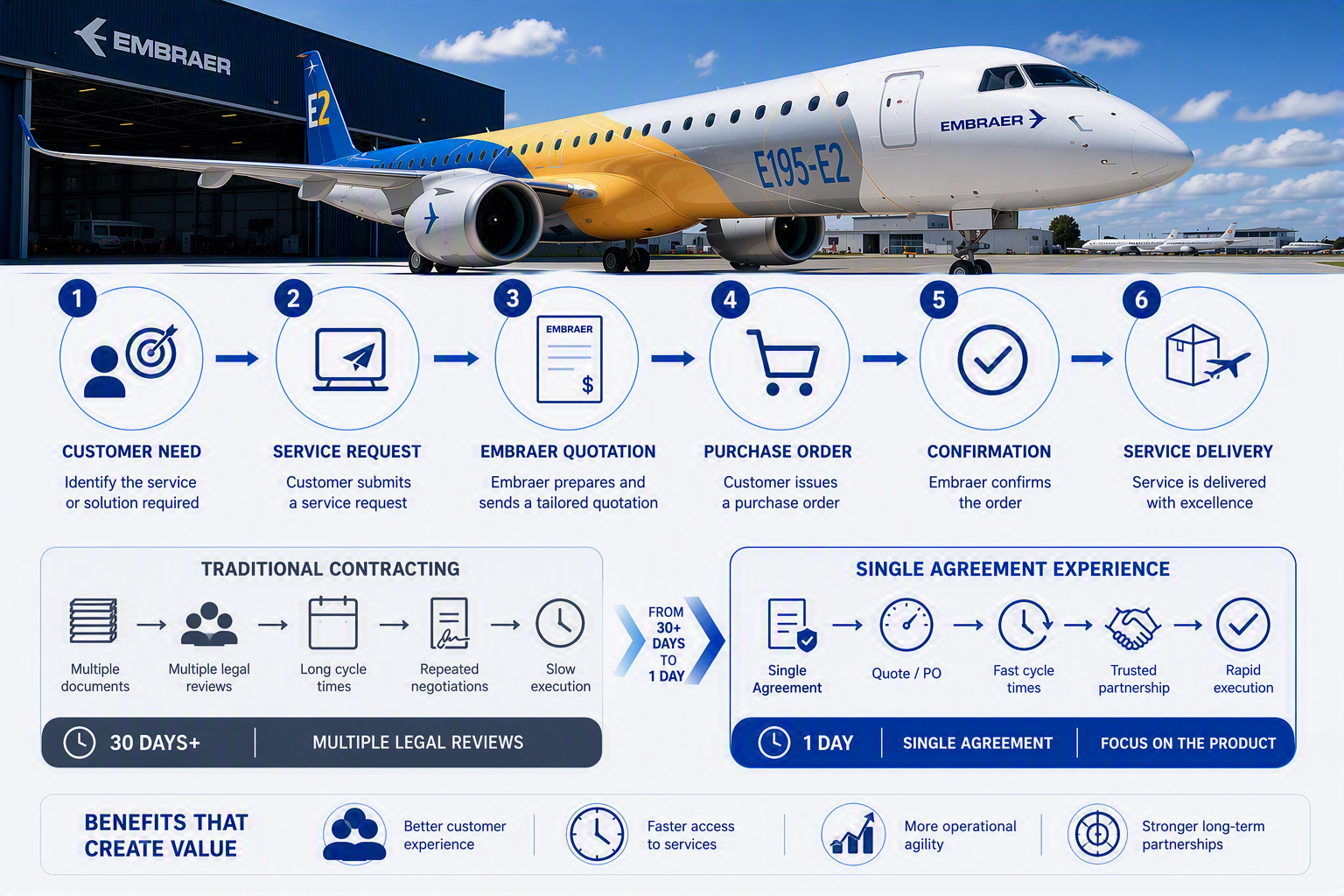
Image source: embraer
Once Single is established, the basic interaction becomes:
Customer need → Service request → Embraer quotation → Customer purchase order → Confirmation → Delivery
Instead of renegotiating legal terms every time, customer and supplier can focus on the service being requested, its price, timing and delivery, whilst also opening the doors for future click-and-buy operations through Embraer’s catalog.
Embraer achieved this by looking for common patterns across very different services. Insurance provides a good example.
Some services involve Embraer personnel physically interacting with an aircraft; others do not. Rather than negotiating insurance requirements separately for every individual service, Single categorizes services according to their risk characteristics and establishes the corresponding requirements once.
The same principle can then be reused across multiple transactions.
This is Minimum Viable Governance in practice: not eliminating necessary controls, but designing them once so they enable repeated decentralized transactions instead of repeatedly slowing them down.
Single can support a broad range of services, including:
spare parts;
pilot and mechanic services;
technical and operational training;
engineering support;
digital services available through FlyEmbraer;
technical publications and engineering information;
aircraft monitoring and performance tools; and
access to Embraer’s 24/7 technical support capabilities.
This makes Single more than an umbrella contract. It becomes a commercial and governance platform through which customers can access a growing portfolio of Embraer capabilities.
Image source: embraer
Starting with the Customer
The initiative has a particularly strong connection to Zero Distance because the transformation did not begin with an internal efficiency program. It began with a customer frustration.
Such customer effectively challenged Embraer to rethink how business between the two organizations could work. The response reflects one of the core principles of Zero Distance: organizations should continuously learn from users and redesign themselves around what they discover.
Instead of asking: How can we make our existing contracting process faster?
Embraer asked a more fundamental question: Why should the customer have to go through this process repeatedly at all?
That shift from improving an existing process to removing much of the need for the process is central to the story.
Turning a Boundary into a Platform
Traditional contracts often define organizational boundaries: who carries which risk, what can be purchased and under what conditions. Single uses those same mechanisms differently.
By agreeing the boundaries once, Embraer creates freedom inside them.
Customers can request different services without rebuilding the governance framework each time. Embraer can respond to demand without restarting a lengthy contracting process.
The result is a powerful Zero Distance principle:
Good governance does not have to create bureaucracy. Well-designed governance can create autonomy.
Outcomes
The first and clearest outcome is radical simplification. Where the combined contractual landscape for individual services could previously represent 500 pages or more, Single consolidates the contractual foundation into approximately 40 pages.
More importantly, the agreement has the potential to dramatically reduce transaction lead time. The first usage of the Single, showed that purchasing a new service could move from approximately 30 days to one day. That represents a potential lead-time reduction of around 99 percent.
The customer request itself becomes lightweight: request the service, receive Embraer’s quotation, issue a purchase order and proceed. The focus shifts from contracting to servicing.
This changes where the bottleneck sits. Once the contractual platform is established, Embraer is no longer necessarily the limiting factor. The customer's own ability to issue the purchase order can become the main administrative constraint.
The model also gives customers much greater flexibility across services with very different durations and characteristics - from an immediate parts transaction to annual digital subscriptions or multi-month pilot services.
According to Filipe, customer feedback indicates that Embraer is the most innovative single contract for broad aftermarket services currently in the market.
Embraer plans to introduce Single more broadly to its operator community, moving the model from pioneering agreements toward wider adoption.
.
Key Insights for Other Organizations
1. Start with customer friction, not internal process efficiency
Single originated in a customer conversation.
The important question was not how Embraer could optimize its legal process. It was how Embraer could remove an obstacle its customers experienced when trying to do business.
That is Zero Distance in its simplest form: use customer friction as information for redesigning the organization.
2. Simplification does not mean removing protection
Aviation requires sophisticated risk management. Embraer did not solve the problem by abandoning insurance, liability or legal safeguards. It identified recurring patterns and designed reusable rules around them.
The lesson is important: Minimal bureaucracy is not minimal governance.
It is the minimum governance required to create maximum freedom and speed.
3. Standardize the foundation, not the customer need
Single does not force every service into the same delivery model. A spare part remains different from pilot leasing, training or a digital subscription. What Embraer standardized is the contractual foundation beneath them.
This creates an architecture in which diverse services can remain flexible while sharing common governance.
4. Platforms can be organizational, not only technological
FlyEmbraer provides customers with digital access to publications, engineering information, monitoring tools, performance software and technical support. Single complements this with a contractual platform.
Together they demonstrate a broader principle of the emerging organization: platforms can provide reusable services and infrastructure that allow value to flow with much less organizational friction.
5. The hardest boundary to remove may be psychological
Perhaps the most revealing learning from the journey was not contractual but human. Changing established contracting practices means asking experienced professionals to question ways of working they may have followed for decades.
As Filipe described it, the challenge can be telling people to effectively: “Forget the contracts you have learned for twenty or thirty years. This is the new model.”
Resistance can even come from customers themselves who want greater simplicity. Different stakeholders experience change differently.
Functions may also perceive simplification as a threat. If a new system means that legal specialists no longer need to participate in every transaction, an understandable question arises: What will my role become?
The parallel with AI and other organizational transformations is striking. Removing bureaucracy requires more than redesigning processes. It requires redefining how people create value.
6. Ask whether the old complexity is actually necessary
The Single initiative is part of a broader simplification mindset within Embraer Legal. Filipe gave another example: Embraer recently transformed an NDA of almost twelve pages into approximately three pages while maintaining the same underlying protections.
The principle is simple: Preserve the value. Remove the unnecessary complexity surrounding it.
Conclusion
Embraer’s Single initiative demonstrates how a seemingly narrow legal innovation can become a powerful example of organizational transformation. It started with a customer saying, in effect: “Make it easier for us to do business with you.” Embraer listened.
Instead of merely accelerating individual contracts, the company challenged why those contracts needed to be repeatedly negotiated in the first place. The result is an enabling contractual architecture that seeks to combine strong governance with radically lower transactional friction.
This reflects several core principles of Zero Distance:
Learning from Customers - the innovation began with direct customer feedback.
Zero Boundaries - recurring legal and organizational barriers between customer demand and service delivery are reduced.
Ecosystem Thinking - customers gain easier access to a broad portfolio of interconnected Embraer capabilities and services.
And ultimately, Single creates the conditions for Win-Win-Win:
A win for customers - faster and easier access to the services they need, with less administrative friction.
A win for Embraer - lower transactional overhead, faster business, and a differentiated customer experience that can strengthen long-term relationships.
A win for the wider ecosystem - people across organizations can spend less time navigating bureaucracy and more time creating value, while a common governance foundation enables services and partners to interact more effectively.
This is an important shift in perspective. The purpose of governance should not be to control every transaction. It should create the conditions in which people and organizations can safely create value together.
In a world where organizations need to respond increasingly quickly to changing customer needs, Embraer is turning contracting from a potential barrier into an enabler of speed, collaboration and shared value creation.
Single therefore demonstrates a central idea of RenDanHeYi: remove unnecessary distance, enable entrepreneurial action, and design the system so that value creation becomes a Win-Win-Win.
Outlook / What’s Next
Single is still at the beginning of its broader journey. Following the pioneering work with this European customer and the first additional customers, Embraer intends to introduce the model more widely to operators and expand its adoption across the global customer base.
The next stage will provide the opportunity to measure the impact at scale: contracting lead time, legal effort, adoption across different services, customer satisfaction and potentially the commercial effect of making Embraer services easier to access.
It will also test an even bigger idea. If a complex, highly regulated aerospace company can establish robust governance once and then allow thousands of future transactions to flow through it with dramatically less friction, the principle can potentially extend far beyond aftermarket contracting.
Single therefore represents more than a new agreement.
It is an experiment in a different relationship between customer, organization and governance - one in which necessary boundaries remain, but unnecessary distance disappears.
All Posts of this Series
Post 1 - A Preview of the Haier ZeroDX Awards 2026
Post 2 - P3 Group Case Study
Post 3 - Embraer Case Study
Post 4 - Gel Studios Case Study
Post 5 - Mercedes Case Study
Post 6 - foryouandyourcustomers Case Study
Post 7 - The Haier ZeroDX Awards 2026 (Staytuned - later in Sep/Oct)