Breaking Down the Silos – Why Agile Delivery Gets Stuck at Procurement (and How to Fix It)
January 2026
By Mirko Kleiner, Thought Leader & President, LAP Alliance – mirko.kleiner@lap-alliance.org
Agile is scaling faster than ever. And yet… many transformations hit the same wall.
Delivery becomes fast. Procurement stays slow.
Teams become agile. Support functions stay sequential.
Planning becomes iterative. Vendor onboarding still takes months.
The result?
👉 Agile delivery accelerates — but the realized value doesn’t.
The whole system gets stuck at the organizational boundary.
And to be clear: this isn’t because procurement is incompetent.
Procurement teams are often the most committed people in the system — they are simply trapped in outdated operating models.
A Systemic Problem (Not a Procurement Problem)
✅ Procurement isn’t the problem.
❌ The way we organize procurement is.
Like Legal, Finance, and HR, procurement literally all supportive functions were built for predictability and centralized control. But the Age of AI requires responsiveness, learning, and cross-functional and cross-company collaboration. When Agile delivery meets traditional procurement, friction is unavoidable: teams move fast while sourcing remains sequential, contracts protect but don’t adapt, and partners are treated transactionally instead of as co-innovators. That’s why procurement becomes a bottleneck — not due to bad intentions, but because the operating model forces it.
👉 I want to address those root causes. What practical steps can we take to truly break down silos — and enable real end-to-end flow across internal functions and partners / suppliers? How do we make procurement faster, safer, and fit for Agile delivery in the Age of AI? Where do we start?
Not in theory — but hands-on and measurable.
💬 Got specific questions? Drop them in the comments — I’ll address them.
📩 Facing concrete challenges in your Agile Adoption? Send me a message.
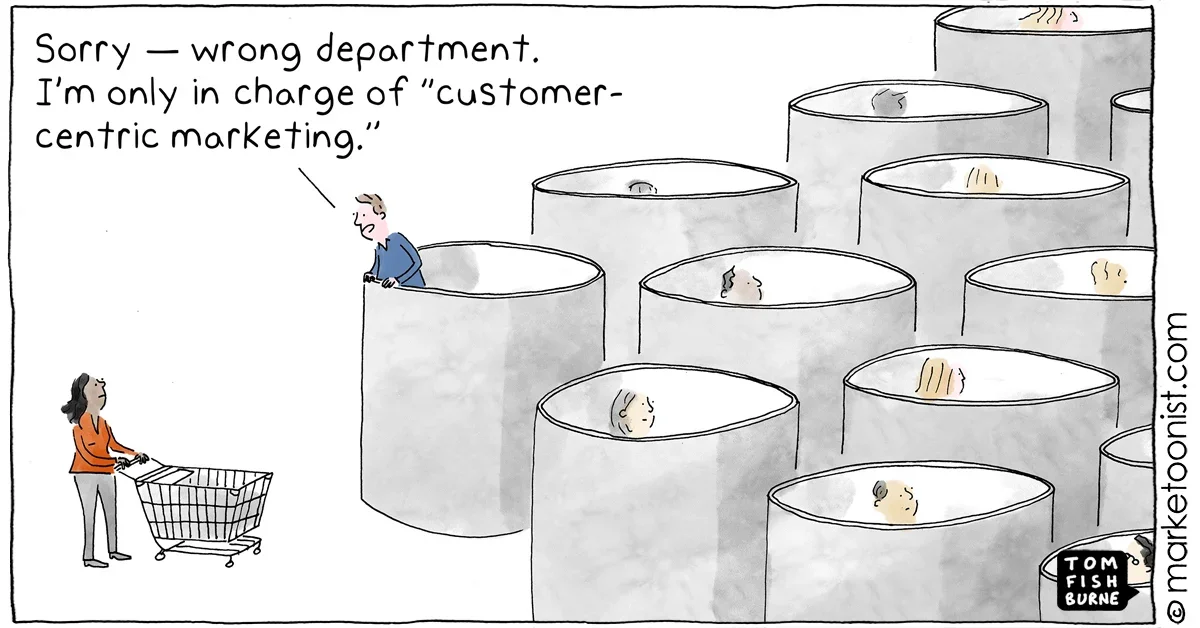
Image source: marketoonist.com
My Observations and Recommendations – Practical, Hands-on, and Measurable
Mirko Kleiner – I’ve been following the Agile community for more than 20 years and consider myself an experienced practitioner in Agile adoption and enterprise transformation. About 10 years ago, with the creation of Lean-Agile Procurement (LAP), I also entered the commercial world — and quickly realized how often the biggest bottlenecks sit outside delivery.
Working with some of the world’s most progressive organizations — including Haier and Roche — and through global collaboration with other tought leaders and 36+ alliances, universities, and certification bodies across the Lean, Agile, Procurement, Legal and Supply Chain communities, I’ve gained a broad end-to-end perspective.
One thing is crystal clear: breaking down silos is not optional if organizations want to unleash their full potential and get ready for the Age of AI.
“Breaking down Silos
is NOT Optional
in the Age of AI”
And the results speak for themselves. Our clients report outstanding outcomes:
Achieve up to 800% faster time-to-market, aligned with Agile cadences.
Realize 80% better commercial outcomes through co-creative partnerships.
Transform traditional supplier relationships into long-term co-innovation ecosystems.
Build compliant yet adaptive procurement capabilities that match the speed of delivery.
Do you want your strategic procurement done in days/weeks, not months/years? Let’s make it happen and check out my observations and practical recommendations for improvement.
🧩 Observation #1 – Procurement Becomes the “Enemy” (Even Though It Isn’t)
This is one of the most destructive transformation dynamics. Agile teams are measured on speed and value delivery. Procurement is measured on compliance, cost control, risk avoidance, sustainability. So both parties behave rationally — and still clash. Delivery says: “procurement blocks innovation.” Procurement says: “delivery is reckless and non-compliant.”
Both are correct within their current KPIs and structures while playing a different role to maximize business value and minimize risk.
My recommendations – Practical, hands-on, measurable
Shared objectives & metrics: In the age of AI, what ultimately matters are business outcomes and measurable impact. For procurement, this means that speed, adaptability, and value creation must become just as important as traditional commercial KPIs and compliance. A siloed focus on “service metrics” alone is no longer fit for purpose — it belongs to the past.
One Business Portfolio & -Priority: Procurement must be involved from day one — from the first business idea — not months later when decisions are already locked in. And instead of running isolated project pipelines per function, organizations need one shared business portfolio and one set of enterprise priorities that everyone executes against. This way we do have a more focus, diverse view and risk mitigation from the start.
Customer centricity: The business and procurement must optimizing for customer outcomes — whether the “customer” is an end user, a business unit, or the value stream itself. In an ecosystem economy, suppliers and partners are not just cost factors; they are part of the customer value creation system.
🧩 Observation #2 – Scaling Procurement (and any other support function) doesn’t work & always will be a bottleneck
This is an ongoing debate in the procurement community: centralize vs. decentralize procurement.
But here’s the hard truth: scaling procurement as a function doesn’t work. And it makes little difference whether it’s centralized, decentralized — or some hybrid in between. (By the way, this applies to any support function.)
I’ve seen procurement organizations with 800+ employees — and it still wasn’t enough.
Why? Because even with shared objectives, if your enterprise has 100,000 employees, there are simply too many requests. Procurement gets overwhelmed — not due to lack of effort, but because the operating model is wrong.
Support functions are still run as transactional service desks: someone submits an input → procurement processes it → an output is delivered. A classic “we do it for you” approach.
This model from the past will always become a bottleneck.
So the real question is:
👉 What is the operating model that actually works — and fits the needs of Age of AI?
“Procurement Must Shift from Function to Capability ”
The real answer is simple: procurement must shift from a function to a capability. Tim Cummins, President WorldCC and I have published a Whitepaper a few years ago about it. Check it out for free download.

Twenty years ago, quality assurance in software development was a separate, centralized function. It followed a transactional model — teams “handed over” work, QA inspected it, and then returned an output. In many ways, it worked exactly like traditional procurement still does today.
But modern Agile and DevOps changed that. Quality is no longer a department — it is a capability built into every team. The people who create value also own quality, supported by shared standards, automation, and guardrails.
The same shift is now required for procurement.
The most progressive organizations — such as Tesla, SpaceX, Haier, and Roche — have applied this shift beyond software delivery, including procurement: embedding commercial and partner responsibility into the value stream, supported by platform-style enablement rather than centralized gatekeeping.
My recommendations – Practical, hands-on, measurable
Get your homework done - Automate operational procurement: Procurement organizations often say: “We don’t have time for new ideas.” And frankly — as long as 99% of the workload is operational procurement, that’s true. But that’s exactly the problem: if procurement remains buried in low-value transactional work, it will never have the capacity to evolve into an enabling capability for the Age of AI. So start with the basics: automate operational procurement and turn it into business self-service. Free up capacity by eliminating repetitive tasks and simplifying the workflow. Beyond automation, go after quick wins such as simplify and reduce approval layers, standardize low-risk purchases. Then reinvest the freed-up capacity: upskill and enable procurement talent to focus on the work that will matter in the future.
Embed strategic procurement capability into value streams: Use your next strategic sourcing case to test a “we do it with you” approach — for example by applying Lean-Agile Procurement. Run it collaboratively as part of the DevOps teams. And keep the long-term vision in mind: this is not just about winning one sourcing case faster. The real goal is to enable value streams to handle future procurement more independently.
Get the conversation started: The shift from function to capability is not a procurement-only task. Start the conversation with leadership and the business about what they will need to succeed in the Age of AI. Most likely, they will ask procurement to evolve into a Platform Team: enabling value streams with guardrails, self-service tools, market-/supplier insights and coaching rather than operating as a transactional service desk.

Source: LAP Alliance - Learn more about Procurement Platform Teams in our Whitepaper at the end of the blog post post
🧩 Observation #3 – This Is Not Decentralization Without Governance
Let’s address the elephant in the room. Whenever people hear: “The business / Agile Teams should own partnerships and sourcing decisions” …they immediately fear chaos, maverick spend, and compliance violations. That fear is justified — if you decentralize procurement capabilities the traditional way.
So let me be explicit:
✅ This is not traditional decentralization
✅ It is a business empowerment with procurement-designed guardrails.
In the future procurement operating model, procurement doesn’t disappear. Procurement evolves — from a transactional “we do it for you” function into a “we do it with you” Platform Team that scales!
The big mindset shift is this: historically, procurement made the rules — often with good intentions, but too often creating unnecessary bureaucracy. In the Age of AI, the business must be treated as the internal customer. It funds procurement activities and therefore has the right to define the service levels and speed it needs.
The Procurement Platform Team then designs and delivers those services — grounded in procurement best practices, but optimized for flow, adaptability, and outcomes. In the most progressive organizations — such as Haier — procurement has even evolved into a profit center, funded through the value of the services it provides.
The Procurement Platform Teams typically provides:
Self-service tools, Guardrails, compliance frameworks, such as Agile contract templates
Realtime Market intelligence and vendor insights
Enablement, Mentoring, and Coaching
So teams can move fast — within clear boundaries and compliant guardrails.
My recommendations – Practical, hands-on, measurable
Gather business requirements & redefine services Understand today’s top business challenges — and how procurement can add measurable value in solving them. Then co-create with the business and Agile/DevOps teams the top 3–5 services the Procurement Platform Team should provide (and the service levels expected).
Co-create new governance for the Age of AI Define the future operating model for procurement in the Age of AI. Clarify the new distribution of decision rights and responsibilities, including how teams will work across different procurement scenarios (Category management, sourcing, supplychain management, etc).
Set up a cross-functional Procurement Platform Team Build and enable a cross-functional team based on the services and governance defined above. This team should operate as an agile Platform Team — providing automated services such as market insights, enablement, coaching, and reusable guardrails. Ensure it can run as independently as possible by including the right capabilities: procurement, legal/compliance, technology, data, and AI expertise.
🧩 Observation #4 – AI & Technology are used to digitize the old operating model — instead of redesigning it.
Many procurement functions proudly invest in AI and technology — dashboards, spend analytics, contract lifecycle management, supplier risk tools, RPA, chatbots, etc. But when you look closer, most of these tools are designed to make the procurement function more efficient, not to scale Procurement Capability into the business / agile Teams.
AI becomes a better “back-office engine” — but not a self-service capability for value streams.
So instead of removing bottlenecks, technology sometimes reinforces them:
the tools sit in the procurement silo
the business still needs tickets and approvals
Agile teams still can’t move at the speed of delivery
procurement remains the “single throat to choke”
In short: we digitize the old operating model — instead of redesigning it.
My recommendations – Practical, hands-on, and measurable
Categorize business requirements Break down the business requirements and decide what belongs where: What can be fully digitalized / automated? What is already digital, but could be significantly improved with AI? What is critical now — and what can realistically be delivered later? This creates focus and prevents over-engineering.
Test fast — and test with real users Whatever technology you introduce, treat it like a startup would. Become the product owner of the procurement platform, start with the User and think in MVPs (Minimum Viable Products) — as if the success of the platform depends on it (because it does). And don’t build tools in isolation: test early, test often, and test with the people who will actually use them — business / Agile Teams. If you’re new to agile ways of working in procurement, start with Lean-Agile Procurement as a pragmatic entry point.
Platform approach (design for the business, not for procurement experts) Any tool you evaluate or improve must be designed for the real users: the business / Agile Teams, partner / vendors — not procurement specialists. If procurement is moving toward a Platform Team, the technology must follow the same logic: simple, intuitive, self-service, and guardrail-driven. In consequence, platform tools often need to become much simpler — because the users are no longer procurement experts, but delivery teams who need speed and clarity within defined boundaries.
So, “What’s the Roadmap?”
This is where CEOs and transformation leaders always ask: “Ok Mirko — what’s the roadmap?”
Here is a pragmatic high-level roadmap that works:
Phase 1 — Diagnose (2–4 weeks)
map procurement lead times & delay drivers
identify top 3 bottleneck categories (vendor onboarding, contracting, evaluation, compliance)
quantify cost of delay (this unlocks executive urgency)
define a joint ambition with the leadership including the business / agile teams
create or extend an existing transformation team
Phase 2 — Pilot one value stream (4–8 weeks)
select one strategic sourcing challenge
run one pilot with Lean-Agile Procurement
co-create a contract using modular agile patterns
measure cycle time + stakeholder satisfaction and compare it with the ambition
Phase 3 — Build procurement-as-platform (3–6 months)
take the learnings from the pilot
empower a new product owner procurement platform team
develop platform team services for one value stream
(incl. templates + playbooks + guardrails + coaching pool)develop an intelligence hub for market insights / vendor + category management as needed
extend or develop an MvP of an enablement program
Phase 4 — Scale capability (6–18 months)
scale platform team services to further value streams
create ecosystem governance models for long-term co-innovation
This Is Not a Procurement Transformation. It’s an mandatory Upgrade of your Operation Model for the Age of AI.
Breaking down silos isn’t about culture posters. It’s about operating model design. If you introduce AI and/or Agile delivery without redesigning procurement and other support functions, you get:
🚧 fast teams blocked by slow governance
But if you redesign procurement into a platform capability and embed it into value streams, you unlock:
speed with safety
autonomy with alignment
compliant adaptability
ecosystem innovation
true end-to-end flow
And yes — it also creates new demand (and huge value opportunities) for:
ecosystem setup & orchestration
enablement and capability-building
commercial coaching
platform tooling
contracting modernization
💬 Got questions? Drop them in the comments — I’ll respond personally.
📩 Want to improve your procurement operating model? Let’s talk.
Because agility doesn’t stop at your organization’s edge — it starts where collaboration begins.
Getting Started with Lean-Agile Procurement
Transforming procurement is not a top-down project—it’s an evolutionary journey.
Start with one value stream, one sourcing challenge, and one collaborative experiment.
From there, the momentum builds.
To deliver faster and smarter in an uncertain world, enterprises must build ecosystems that learn and adapt together. The Lean-Agile Procurement Competency helps make that possible—transforming procurement into an enabler of cross-company flow, co-innovation, and continuous value creation.
We are incredibly proud to see LAP formally recognized as a core SAFe competency. It proves that organizations can transform procurement into a key accelerator of business agility across the entire value stream — not just internally, but across companies and ecosystems.
Get started with LAP today by downloading our free LAP Alliance Whitepaper: Boost Your SAFe Implementation with Lean-Agile Procurement and explore the LAP Competency to see how SAFe organizations are already scaling flow across their ecosystems.
Because agility doesn’t stop at your organization’s edge—it starts where collaboration beg
FREE Download the LAP Alliance Whitepaper
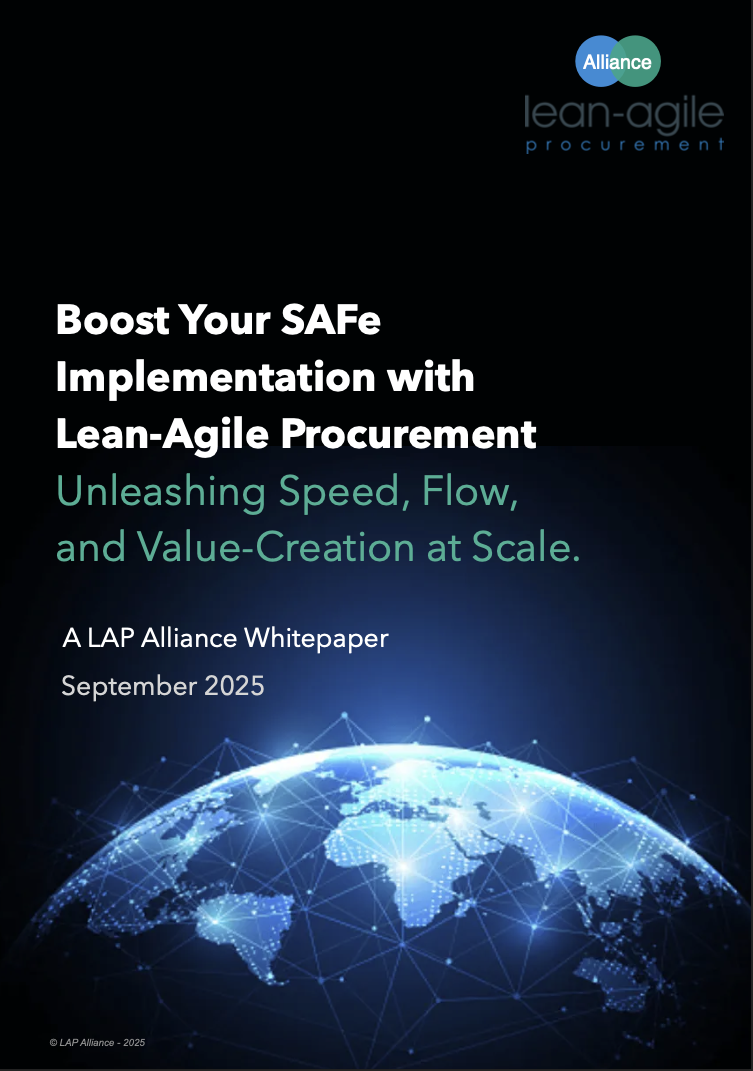
Unleashing Speed, Flow, and Value-Creation at Scale.
By integrating Lean-Agile Procurement (LAP) into the Scaled Agile Framework (SAFe), procurement evolves from a gatekeeping function into an embedded organisational capability. Agile Teams, Agile Release Trains (ARTs), and Solutions take end-to-end responsibility for sourcing, contracting, and partner management, supported by an Agile Procurement Platform Team that provides tools, insights, enablement, and guardrails.
Want to learn more?
This LAP Alliance Whitepaper is inline with other publications such as:
The future of Procurement: From Function to Capability - A survival Guide for Leader that want to transform their procurement organization (co-published with WorldCC)
Complex sourcing with faster and better outcomes - Lean Agile Procurement (LAP) is a rapid and highly collaborative sourcing methodology. Practitioners are benefiting from enhanced outcomes (co-published with CIPS)
Lean-Agile Procurement Competency - Knowledge Paper for SAFe (co-published with ScaledAgile)
Get the official Book:
„Lean-Agile Procurement - How to get Twice the Value in Half the Time“
Get certified:
Check out our Curriculum of Certification Courses
Get coaching: Check out our experts & trainers at LAP-Alliance.org/trainer/find-your-trainer
This announcement was co-published with Scaled Agile inc. the creator of SAFe.
Author